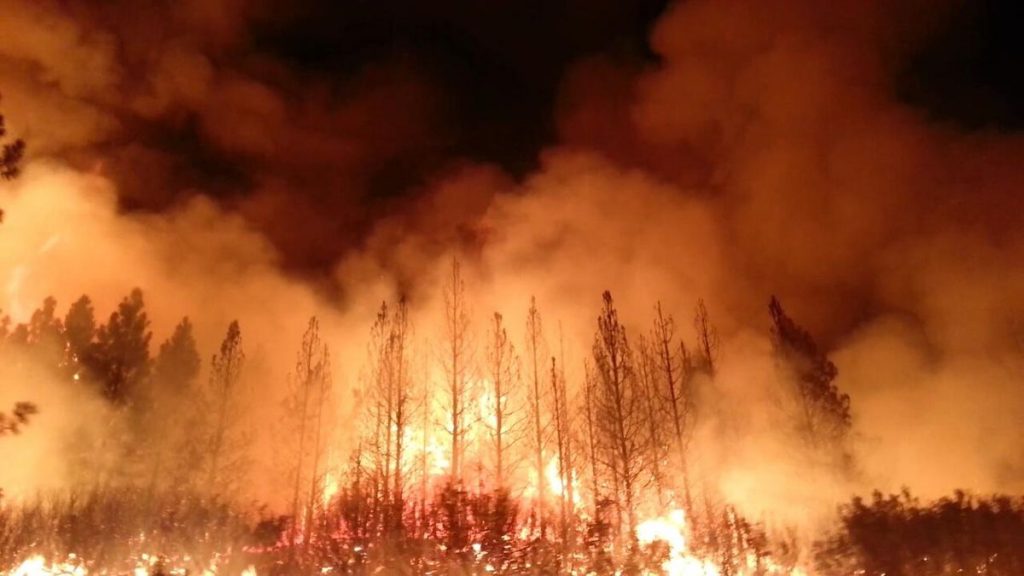


The 2018 wildfire season is the most destructive and deadly wildfire season on record in California, with a total of 8,434 fires burning an area of 1,890,438 acres (765,033 ha), the largest amount of burned acreage recorded in a fire season, according to the California Department of Forestry and Fire Protection (Cal Fire) and the National Interagency Fire Center (NIFC), as of December 6.[1][2][3] The fires have killed 98 civilians and 6 firefighters. In economic terms, they have caused more than $3.5 billion (2018 USD) in damages, including $1.792 billion in fire suppression costs.[4][5][6][7] Through the end of August 2018, Cal Fire alone spent $432 million on operations, according to Wikipedia.
Previously, the 2017 California fire season had broken the record as the most destructive in state history; 8,775 fires burned 1,358,448 acres. Tragically, fatalities included one firefighter and 45 civilians. The total economic cost , according to AccuWeather, is estimated to be at least $180 billion dollars (2017 USD)
Since the year 2000, there have been an average of 8,087 fires a year destroying an average of 649,674 acres. Every year, California is forced into playing defense against; limited water supplies, shifting weather conditions, limited budgets and manpower.
In every neighborhood in the U.S. it is mandatory to have fire hydrants installed. These have been very effective in allowing firefighters to quickly provide water to battle a house fire. Unfortunately, fire hydrants are not enough to battle wildfires. To effectively put down a firestorm, you need something a lot more powerful. Traditionally, aircraft have been used to dump water or fire retardant on the flames, but there are some very big drawbacks; it takes time to get the aircraft to the general area of the fire, the aircraft have to be loaded with either water or fire retardant, once they empty the load, they have to go back and refill. On top of all that, they can only make so many runs before the aircraft have to refuel. All of this takes precious time and the effectiveness is limited.
Firefighters on the ground have been essential to battling firestorms, however, human resources are stretched so thin, they have to utilize prison inmates to battle fires.
The technological answer to putting a stop to this tragic nightmare, lies in a seemingly unlikely place at the heart of California’s agriculture industry. The farming community has been using irrigation and water cannons to water crops for many years. Water cannons are very good at distributing a lot water onto large areas of land over great distances. Every neighborhood in California should be equipped with either a permanent network of water cannons OR portable, modular water cannons that can be quickly assembled by the local fire department where-ever needed.
The permanent water cannons would need to be located on poles tall enough to prevent injury to both residents and property while providing the range and coverage area needed. Local fire departments could activate the water cannons remotely, as needed, to protect any given area. When a firestorm approaches a neighborhood, fire authorities will alert residents and provide instructions to either remain indoors or evacuate according to whatever safety guidelines were pre-established by California fire authorities. The cannons would be activated, dousing the entire neighborhood and effectively halting the fire.
Fires throughout California could be effectively controlled using a network of water cannons throughout the entire state. The entire network could be paid for through a combination of funding sources. Neighborhoods that implement water cannons could see a return on investment through cheaper home owner insurance. The insurance industry and the state of California could work together to jointly fund the network of water cannons in a win win partnership, saving the state and the insurance industry from multi billion dollar losses.
Obviously a network of water cannons would need a very reliable water supply. To prevent any shortage of water in an emergency, California should bolster its water supplies utilizing a network of solar and wind powered desalination plants. Fortunately, Earthensource has that covered. Check out the article; How California Could End Drought Forever and Make a Profit.